Sunday, March 30, 2014

iPhone VS. Traditional Camera: What the Experts Say


Over spring break, I travelled to Boston in order to participate in an a cappella competition.  On my downtime, I explored the city with my Dad, taking pictures at almost every location.  But I did not do so with a standard camera--  instead, I used my iPhone 5S to snap said pictures.

But are they up to snuff?

In late 2013, Sean Captain, a writer for a technology magazine called Tom's Guide, published an article about the growing use and popularity of smartphone cameras in relation to their ability to shoot quality photos.  He discusses how, in the beginning stages of Apple's iPhone development, "The first three iPhone models (original, 3G and 3GS) had abysmal cameras that, ironically, may have jump-started the photo-app craze."  The ability to quickly point, shoot, store, and share photos outweighed the quality. 

However, in 2010, Captain mentions Apple's advancements in quality that put it on the map with other high-end cameras.  The introduction of a sensor into the iPhone 4 which included  "just-emerging technology called (unfortunately) backside illumination" propelled the iPhone into photographic stardom.  "This tech moves a lot of the wiring to the back of the sensor where it won't block light from reaching the pixels in the front."  This technology was developed in the newest iteration of the iPhone via the "True Tone flash" feature, which "mi[xes] the light from two LEDs — one white and one amber...[and] match[es] the lighting in any environment, complementing rather than contrasting with it." 


In comparison to real cameras, iPhone also made advancements in its high-speed capabilities.  Captain describes the iPhone's ability to shoot 10 photos per second, saying that "The iPhone analyzes burst[s] of images and picks the best one to use as the final photograph. Sony pioneered similar technology several years ago in its Cybershot point-and-shoot cameras and then expanded out to higher-end models, such as its NEX Mirrorless cameras. That was a killer feature that point-and-shoots had over smartphone cameras. Not anymore."  Clearly, Apple was gaining on the competition.


So, in all, what makes the difference?  Portability?  Quality?  Price?  Tradition?

This is a photo of the view from the Performing Arts Theater at the Berklee College of Music in Boston. I shot this photo with my iPhone 5S.  You decide, America.


Wednesday, March 12, 2014

How to Change Your Baby's Life...Forever


As with every Conducting II class, my professor always uses a bizarre anecdote that relates to a technical issue of a particular student's conducting.
   
This week, a student conducted the group in a four-part choral arrangement of "O Nata Lux" by Morten Lauridsen, an excerpt from his cycle Lux Aeterna.  One thing the student conductor failed to do is breathe with the singers on their entrances.  Instead of immediately launching into a discussion on synchronized breathing/cueing techniques, he began to describe his experience with the following commodity:


As a father with two infant children, my professor explained how the apparatus was a  "life-saver" for him and for his children.  And the student gained a newfound understanding on the importance of breathing correctly.  Meanwhile, the rest of the class had a laugh for 5 minutes or so.  


Saturday, March 8, 2014

AI: Artificial Invasion


The end of the world:  a topic that isn't necessarily the best topic for small talk at a party, but still merits attention nonetheless.  So then, among the experts at institutes such as the Future of Humanity Institute at the University of Oxford, UK (whoa, that place isn't real, is it?  Yes, it is.), what outcome has the largest probability of decimating the human race?


Zombie outbreak?


Nope.


Nuclear war?


Not really.


An coup d'état perpetrated by various forms of artificial intelligence?


Bingo.


Unfortunately, there is not much attention given to the subject. “I think there’s more academic papers published on either dung beetles or Star Trek than about actual existential risk,” says Stuart Armstrong, a philosopher and Research Fellow at the institute.

Especially for AI, the focus and discussion does not exist in abundance.  Regardless, people such as Armstrong still stress the importance of the issue.  In his research, he gives a statistical example detailing the possibility of total human extinction in various end-of-the-world scenarios.

“One of the things that makes AI risk scary is that it’s one of the few that is genuinely an extinction risk if it were to go bad. With a lot of other risks, it’s actually surprisingly hard to get to an extinction risk... You take a nuclear war for instance, that will kill only a relatively small proportion of the planet. You add radiation fallout, slightly more, you add the nuclear winter you can maybe get 90%, 95% – 99% if you really stretch it and take extreme scenarios – but it’s really hard to get to the human race ending. The same goes for pandemics, even at their more virulent."


But it isn't the Terminator that Armstrong fears.  He fears the AI that is "smarter than us – more socially adept...better at politics, at economics, potentially at technological research.”

Armstrong goes on to discuss the myriad factors that accelerate the "Robot Uprising."  One factor, which can be seen in modern society, is the presence of machines in the workforce.  Armstrong expands the concept tenfold, saying that “You could take an AI if it was of human-level intelligence, copy it a hundred times, train it in a hundred different professions, copy those a hundred times and you have ten thousand high-level employees in a hundred professions, trained out maybe in the course of a week. Or you could copy it more and have millions of employees… And if they were truly superhuman you’d get performance beyond what I’ve just described.”

Okay, so robots take our jobs.  But where does the human extinction part come into play?

“Take an anti-virus program that’s dedicated to filtering out viruses from incoming emails and wants to achieve the highest success, and is cunning and you make that super-intelligent... Well it will realize that, say, killing everybody is a solution to its problems, because if it kills everyone and shuts down every computer, no more emails will be sent and and as a side effect no viruses will be sent."  

Wow.

But perhaps a safeguard, such as the "Three Laws of Robotics" from iRobot, would keep us mouth-breathers safe? 

“It turns out that that’s a more complicated rule to describe, far more than we suspected initially. Because if you actually program it in successfully, let’s say we actually do manage to define what a human is, what life and death are and stuff like that, then its goal will now be to entomb every single human under the Earth’s crust, 10km down in concrete bunkers on feeding drips, because any other action would result in a less ideal outcome."

Oh.


With the rapid expansion of machinery in the workforce, home, and even battlefield, researchers such as Armstrong are becoming more verbose about their extrapolations.   If the "AI Apocalypse" comes, and humanity has no defense, then it'll be:


before you can say "The Humans Are Dead."


(Sorry, I couldn't help myself.)


Wednesday, March 5, 2014

Response to Shirky: Leave it To the Professionals?


What values are being presented in modern society?  How does technology affect those values?  

Clay Shirky, author of Here Comes Everybody, offers insight into the social and economical contexts that surround the dilemma described earlier in Chapter 1, in which a woman loses her phone and struggles to recover it from the girl who found it in a taxi cab.  Because of the woman's friend, Evan, the story was able to gain local, national, and global attention.

But is this a positive aspect of technology?  Sure, Evan used his digital prowess in order to help his friend get here phone back.  Sasha and her party were being unreasonable and cruel, and given the price of the phone, it was no laughing matter.  However, can this digital networking be used for nefarious purposes? Shirky mentions that Evan was "able to escape the usual limitations of private life and to avail himself of capabilities previously reserved for professionals" and recover the phone for his friend.  Yet, what long-term effects come from undermining the professionals themselves?  


The Internet, in its sheer vastness, allows for anyone to upload anything at anytime.  Non-professionals, who, before the World Wide Web, were left to shout and hock their wares on street corners, now have a voice, and that can be dangerous. 

Tatev Harutyunyan , an Armenian journalist, writes in an article that "the dramatic expansion of online media has damaged Armenian journalism, flooding it with a new generation of unprofessional editors and journalists.”  Information lacks sources and/or proper citation, important topics are undermined and replaced by trivial entertainment, and uniformity in the news business dissolves.  

Could a similar trend be growing in the United States?


I don't know, I'm kind of bored.


Hey, look!  


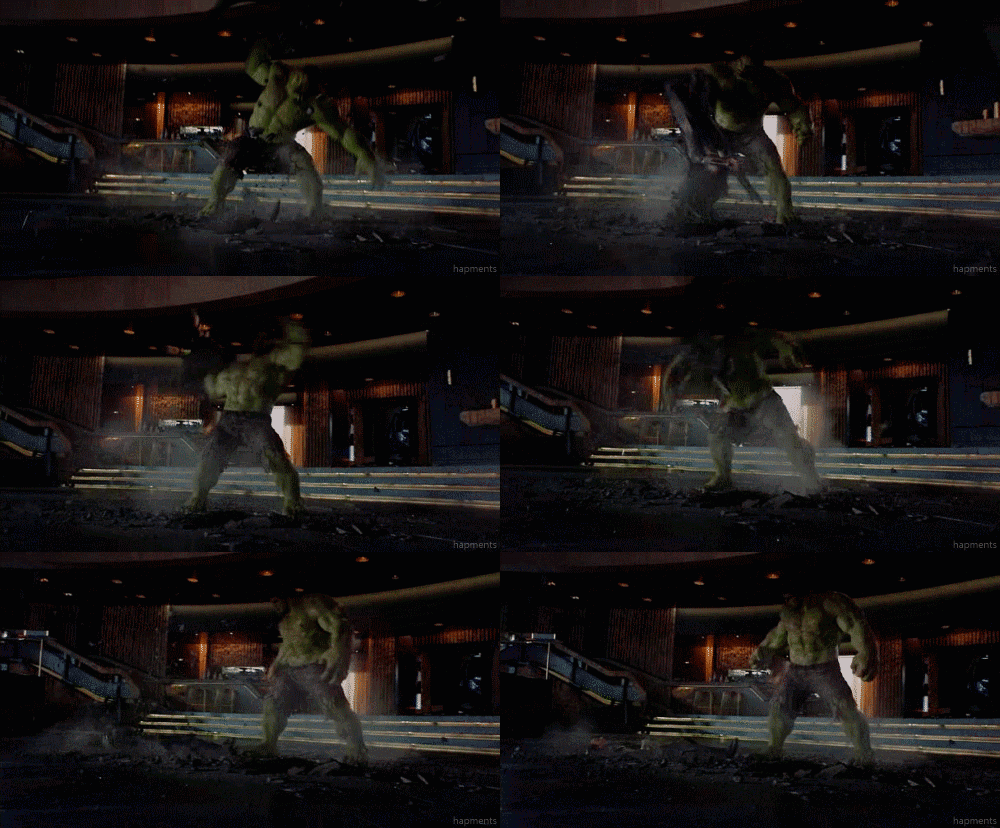
It's Hulk smashing the Asgard out of Loki!


HAHAHAHAHAHAHAHAHA


* Emery, Adam.  "Puny God."  The Revengers. 2014.  Sony Pictures. 

Saturday, March 1, 2014

The YouTube Generation


Almost a year ago today, Google ran an article that analyzed the question of "who watches and contributes to YouTube the most?"  

The research concluded that the millennials contribute to the  "YouTube generation."  According to this study, over 80% of millennials make up the website's audience.  Based on its findings, Google has placed a label on said viewers that not only defines their demographic but also outlines their state of mind — Gen C.


In describing this new label, Google says that "...Gen C is more than an age-group; it's a mindset defined by creation, curation, connection and community."  It is a self-sustaining, expansive, dynamic entity that cultivates expression in every sense of the word.  


Now, while this information may point out a fairly obvious point, namely that twenty-somethings make up the general population of YouTube and social media in general, Google goes on to provide more stats about Gen C.


On the "social" front:


Okay, nothing earth-moving there.  Social media has grown in popularity ever since its conception.  The fact that millennials are proficient in the ways of digital media and technology seems fair.


On the technology front:


Slightly creepy choice of words, even for Google, but still no shocking revelation.  With multiple events and conversations going on at once across the Internet, it's not a stretch to say that smartphone users have a hard time unplugging.


Millennials use smartphones, smartphones have the YouTube, millennials use smartphones to watch the YouTube. Transitive property at work.


On the economic front:


Wait, how much?


Thank you, Google.


500 freakin' billion dollars.  

Generated by Tweets?  And Facebook posts?  And Tumbling???

Ginny Marvin, a writer for Market Land who focuses on online marketing and revenue, concluded that, at the end of 2013, "social media finally seems to have become a part of the revenue equation for many companies."  

(Since you are probably tired of reading numbers, you can view Marvin's statistics and colorful charts here).

Does social media carry more power than previously thought?  Does the generation that spends too much time posting and taking selfies actually contain the potential to change the direction of society? 

Until that question can be answered indefinitely, please enjoy tank missile:


(Because really, nothing is more BA than Iron Man dodging a round, shooting a slightly delayed, lethal explosive, and walking away.
You're welcome.)